
Anderstorp (gmina Gislaved), Sweden
Scandinavian Raceway in Anderstorp: The Bog That Got Formula 1
The history of Scandinavian Raceway in Anderstorp: coffee at Blads, dynamite on a bog, six Formula 1 Swedish Grands Prix, noise disputes and track sessions for road cars.
- Type
- race circuit
- Length
- 4.025 km
- Opened
- 1968
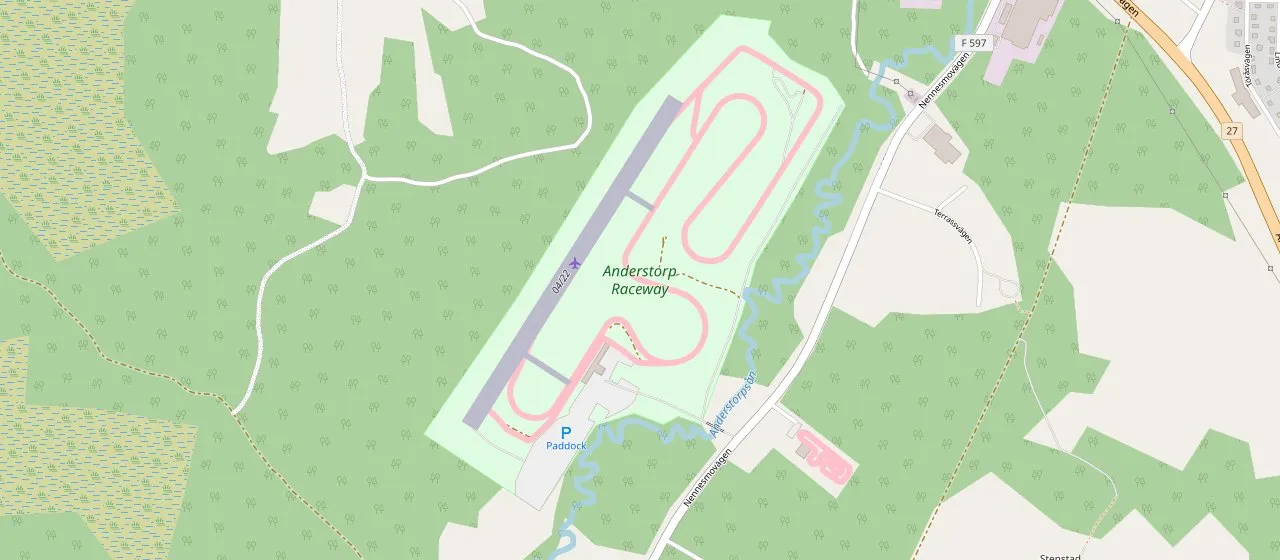
At the end of the summer of 1965, at nine in the morning, three drivers from Team Mosarp sat over their mid-morning coffee in the Blads café in Anderstorp. Sven “Smokey” Åsberg was supposed to bring that day the cost estimate for a track for practice, one and a half kilometres long. “Too expensive,” he said, ate a piece of cake and added that what they needed to build was a big track, four kilometres long, on the Stötabomossen bog. Local industrialists were to pay for it. Eight years later, on 17 June 1973, the first Formula 1 Swedish Grand Prix took place on that bog.
| Location | Anderstorp, Gislaved municipality, Jönköping region (Småland); Nennesmovägen 20 |
| Type | permanent road course whose straight is also the runway of an airfield |
| Length | Grand Prix loop 4.025 km; south loop 2 km |
| Opening | 16 June 1968 |
| Design | engineer Holger Eriksson, adviser Joakim Bonnier |
| Lap record | 1:21.525, Marijn van Kalmthout, Benetton B197-Judd, EuroBOSS, 2009 |
| Formula 1 record | 1:24.836, Niki Lauda, Brabham-Alfa Romeo, 17 June 1978 |
| Operator | SRW Anderstorp AB, a company wholly owned by the Anderstorp Racing Club (since 2015) |
| Major events | Formula 1 Swedish Grand Prix 1973–1978; motorcycle world championship (500 cc class until 1990); ETCC; WTCC 2007 |
| Airfield | ESMP, runway 1000 × 20 m, landing only when nobody is driving on the track |
| Status | active; proceedings for a new environmental permit are under way |
Dynamite on Stötabomossen
Åsberg, Bertil Sanell and Åke Bengtsson, known as “Rörkrökarn”, raced for Team Mosarp and in 1965 were planning a short, asphalt practice track. They found the site two kilometres from the centre of Anderstorp. According to an account published in the jubilee magazine of the Swedish motor sport association (SBF), Åsberg suspected that Stötabomossen was not a real bog and that hard sand lay just beneath the vegetation. To check, he bought dynamite, and the three friends secretly set off trial charges. The ground turned out to be firm, and because they told nobody about it, they bought the bog for next to nothing.
In 1966 the company AB A-ringen and the Anderstorp Racing Club (ARC) were formed. The practice track grew in the plans to more than four kilometres and was combined with a runway a thousand metres long. The airfield was bait for the industrialists: it promised the village a daily connection to Stockholm. The layout was drawn by Holger Eriksson, an engineer employed at Åsberg's firm Industricrom, and the Formula 1 driver Joakim Bonnier served as adviser and link to the international federation. From 1967 the work was carried out by club members, a newly founded flying club and volunteers from Anderstorp, and the contractor was the company Nya Asfalt AB.
The track came out flat as a table. In 1973 Denis Jenkinson of “Motor Sport” described “the flat, arid waste on which the Swedes have built the Scandinavian Raceway on the edge of the little country town of Anderstorp, though from the circuit there is not a house to be seen, just sandy scrub and distant pine trees”. The long constant-radius corners were slightly banked, so setting the car up well was difficult and decided the lap time. An oddity was the start line: in 1968 the inspectors of the Sporting Commission (CSI) refused to allow it on the short straight by the pits and ordered it moved to the longer straight on the other side of the track. The asphalt paddock and the pits were already built, so timekeeping and race control stayed at one end of the site and the pits at the other.
The Five Years Smokey Promised
In May 1968, before the track was officially opened, a “secret” meeting was held. The SBF decided that the new club should not begin with an international race with stars, so the club first had to practise its marshals and officials on the track. The official premiere followed on 16 June. The one-hour sports car race was won by Joakim Bonnier in a Lola T70 ahead of the Australian Paul Hawkins in a Ford GT40. In the Formula 3 race Ronnie Peterson and Reine Wisell, in Tecno cars, swapped the lead on almost every lap until Peterson dropped out with a gearbox failure and Wisell won.
At the press conference after the opening Åsberg announced that Formula 1 would come here in five years. According to Sanell, a surprised silence fell, and then the room burst out laughing. The version recorded in the club's chronicle speaks of journalists from Scania to whom Smokey promised, in the autumn of 1968, a Formula 1 world championship within five years; people whispered among themselves that he had got delusions of grandeur.
In 1969 the track hosted the first round of the Swedish championship, and the main race, the Nordic Challenge Cup, was won by the Finn Leo Kinnunen in a Porsche 908 ahead of Brian Redman, Herbert Müller and Bonnier. Drag racing appeared too, and with it hooligans: according to the SBF magazine they set fire to a small house and harassed the local police, and drag racing was renamed “dräggracing”.
On 28 June 1970 the track hosted a round of the British Formula 5000 series (Guards Formula 5000). On the first lap of the second heat the Welshman Derrick Williams, in a Lola T142-Chevrolet, touched the rear wheel of Fred Saunders's car in the last corner before the start straight. The Lola flew into the air, came down on its roof and caught fire in front of the main grandstand. Williams could not be pulled from the burning wreck; he had turned 37 that day. The race was restarted after nearly half an hour and won by Peter Gethin. Motorsport Memorial, citing the Swedish “Illustrerad Motorsport”, notes that after the accident a campaign began in the Swedish press to end motor racing in the country.
The same year the club organised a trial international motorcycle meeting. Observers rated the track so highly that, contrary to custom, ARC was immediately given a round of the world championship. In 1971 the 500 cc class was won on an MV Agusta by Giacomo Agostini. In 1972 Åsberg negotiated in Belgium with Bernie Ecclestone, the spokesman of the Formula 1 constructors, and the world federation awarded Anderstorp the first Swedish round of the world championship for the 1973 season. That summer Peterson brought a March 721X to the track and, according to the SBF magazine, took the Gislavedkurvan corner in a controlled slide, so that the outer rear tyre smoked.
Six Grands Prix and Not a Single Swedish Win
The first Swedish Grand Prix was watched by more than 50 thousand spectators, among them Prince Bertil. Almost everyone came to Anderstorp straight from Monaco, and “Motor Sport” set out the contrast: from a race through streets between hotels and shops to a track built into a strip of airfield. Peterson dominated practice in a Lotus 72 and led from the start ahead of Emerson Fittipaldi. Late in the race air was escaping from his left rear tyre, and on the last lap Denny Hulme in a McLaren passed him. Hulme won the 80-lap race by 4.03 s ahead of Peterson; François Cevert was third. Reine Wisell did not even reach the start: in a hired March, a front suspension mounting broke on the warm-up lap.
The grandstands added at the exit of the last corner took the place of the run-off; after the drivers' complaints, a chicane appeared at the Norra Kurvan corner for 1974. Jenkinson was not enthusiastic about the track itself. He called it “a Super Slot Track”, “the sort of shape you make in your lounge with Scalex kit”, but praised the friendly atmosphere and Åsberg, who was the clerk of the course and whose word was law.
“Sven Asberg is known affectionately as “Smokey” as he is seldom seen without a long cigar stuck in his mouth, and it never seems to get any shorter as the day goes on!”
The results seldom went the hosts' way. In 1974 Jody Scheckter and Patrick Depailler won in Tyrrells, while Peterson dropped out on the eighth lap with a broken driveshaft. In 1975 Niki Lauda won in a Ferrari, and Peterson finished ninth, just ahead of Torsten Palm, who was driving his only Grand Prix in a hired Hesketh. In 1976 the first two places went to the six-wheeled Tyrrell P34s of Scheckter and Depailler, and Gunnar Nilsson in a Lotus ran into the pit lane wall on the second lap. The 1977 race was won, unexpectedly, by Jacques Laffite in a Ligier with a Matra engine. The author of the SBF magazine text, Sveneric Eriksson, who was then the announcer in the pit lane, recalled that the organisers had no recording of the French anthem, so he began whistling and humming it, the crowd in the grandstands picked up the tune, and Laffite wept with happiness.
The last Grand Prix, on 17 June 1978, went down in history because of a car. Brabham brought the BT46B with a large fan at the rear: the team claimed that the fan drew air through the radiator, but it also sucked air from under the car, which was sealed with flexible skirts, and pressed it to the asphalt. The Swedish organisers rejected five official protests. Lauda pressed Mario Andretti in a Lotus 79 for 37 laps, took the lead on lap 38, and eight laps later Andretti's engine blew up. Lauda won by more than 34 s ahead of Riccardo Patrese, and Peterson, who had dropped to 17th place after a puncture, fought his way up to third. Lauda's fastest lap, 1:24.836, became the Formula 1 record at Anderstorp, because there was no next Grand Prix. After practice Peterson complained about the pebbles that the fan showered on those driving behind.
“Being stuck behind it was bloody awful.”
The car with the fan never started in another race. In 1978 Peterson died after an accident at Monza, and Gunnar Nilsson died of cancer. Costs were rising, sponsors were lacking, and the 1979 Grand Prix was cancelled; according to the SBF magazine a wealthy sponsor appeared at the last moment, but the decision had already been made.
Motorcycles, Volvos and the Night of 1993
Motorcycles stayed at Anderstorp longer than Formula 1. According to the club's chronicle, in the 1980s the 500 cc class here was won by Barry Sheene, Freddie Spencer, Eddie Lawson and Wayne Gardner, and the last round, in 1990, by Wayne Rainey. Among riders a joke went round that the best thing about Anderstorp was the airfield, because after the race you could quickly fly away. In 1985 the European Touring Car Championship (ETCC) came, and Volvo scored a double victory: Gianfranco Brancatelli and Thomas Lindström won ahead of Ulf Granberg and Anders Olofsson. In 1987, when the series had world championship status, the Germans Altfrid Heger and Winni Vogt won in a BMW.
The most dramatic event in the club's history fell on 18–20 June 1993, when the 24-hour round of the motorcycle endurance world championship was to be held. A week earlier an appeal against the permit had been lodged because of the noise. The permit arrived only on the morning of the race day, after the intervention of, among others, the county governor, but all week the media had reported that the event was cancelled. At the ferry ports in Scania customs and border guard staff turned back fans from Denmark and the continent, and then, as the club writes, the worst storm of the century broke over the track, with thunder and a downpour that lasted for most of the race. The team Kawasaki France won, and ARC had to declare bankruptcy. In the autumn of 1993 the club was reorganised as the Nya Anderstorp Racing Club. Bertil Sanell wrote later that the motorcycle world championship ended here in 1993, when a local authority set noise levels that ruled out events of that rank.
From GT to WTCC
In 1995 the GT BPR series came, and according to the club the grandstands filled as in the days of Formula 1. The hosts' favourite Anders Olofsson, in a Ferrari F40, dropped out after a collision, and Michel Ferté and Olivier Thévenin, also in an F40, won. The same year the run-off areas received gravel traps filled with expanded clay (Leca balls); the club credits the solution to itself, because the washed Danish gravel recommended by the FIA had to be replaced with something. In 1997 the Swedish Touring Car Championship (STCC) made its debut, and one of the two races was won by 18-year-old Mattias Ekström. Towards the end of the decade the running of the facility was taken over by the company Scandinavian Competition Services AB, founded by four club members, because with rising financial demands it was ever harder to run the facility on a voluntary basis.
Noise returned in later decisions. In 1999 ARC gave up the popular public motorcycle track days, because they exceeded the limits. After the ETCC rounds in 2002 and 2003 a building with pits, offices and a media centre was built at the track, and in 2005 the STCC returned. Markus Egerhall of the track's organisation announced then that before the race the “world famous toilets” would be upgraded. According to the SBF magazine the new leaseholder invested in the pit building, in August 2006 the track was reopened, and a motorsport-oriented upper secondary school started in the new building.
In February 2007 the FIA moved the seventh round of the World Touring Car Championship (WTCC) from the Istanbul Park circuit to Anderstorp. In the second race, on 29 July, Rickard Rydell, in a fourth, additional Chevrolet Lacetti, started from ninth place on slicks on a wet, drying track. On the last lap he passed his teammates Nicola Larini and Alain Menu. Larini, who had led all laps but the last, did not hide his displeasure. In 2008 the track hosted the Ronnie Peterson Historic GP, and Stefan Johansson won both races in a March 761, without coming near Lauda's record. The fastest lap in the history of the facility was set in 2009 by Marijn van Kalmthout in a former F1 car, a Benetton B197.
Noise, Permits and the DTM That Never Came
In 2015 the running of the track was taken over by the club itself through its wholly owned company SRW Anderstorp AB, registered on 24 February that year. In September 2019 ARC agreed with the promoter ITR that a DTM round would be held at Anderstorp on 12–14 June 2020, the first international car racing event at this track, and in the whole country, since the WTCC in 2007. The COVID-19 pandemic ended that plan. “For us and for Swedish motorsport this is of course a big loss,” said the president of Scandinavian Raceway, Peter Eklund.
Noise limits govern the circuit today. In May 2018 the building and environment committee of Gislaved municipality imposed precautionary measures on the track, valid until a new permit was issued. The permit was issued on 14 April 2020 by the environmental assessment delegation at the Östergötland county administrative board, but it was appealed, and in March 2022 the 2018 decision was still in force. The authority named the company Gisletorp Lokaler AB as the operator. The operator writes in 2026 that the permit proceedings are continuing and that until a final decision the track operates on the basis of the notification of 21 May 2018. In the 2026 calendar every day has its own limit: on race days 98 dBA measured at the track and 78 dBA at residential buildings, on corporate event days 65 and 45 dBA.
Road Cars Welcome
An amateur driver can take his own car onto the Grand Prix loop during ARC's evening practice sessions (Kvällsträning BIL). “Road cars are welcome,” writes the club, and alongside the groups for race cars it creates a separate group for them, with a simplified technical inspection before the start. The driver must have a helmet, clothing covering the whole body, shoes and gloves, and the car's noise must not exceed 95 dB. In 2026 such evenings were planned for 21 April, 21 May and 13 August; a session cost 650 kronor for club members and 800 kronor for others, and a driver without a licence paid an extra 150 kronor for a one-off SBF licence. The track's calendar also includes track days for companies and organisations, for cars and motorcycles, without naming the organisers.
By the track one can rent one of 23 garages or one of 12 camping cabins, although during competitions the club takes the cabins for officials. The airfield by the track was officially closed in 2013, after the transport authority found serious irregularities. Today it again receives aeroplanes and helicopters, only with prior permission, because the runway and the race track are the same asphalt. An aircraft may land only when nobody is driving on the track, on the western 20 metres of the thirty-metre-wide asphalt, which in the 1970s was the Grand Prix straight.
Timeline
- 1965: Åsberg, Sanell and Bengtsson plan a practice track
- 1966: trial blasts on Stötabomossen, AB A-ringen and the Anderstorp Racing Club are formed
- 1968: a secret meeting in May, official opening on 16 June, Joakim Bonnier wins
- 1970: a Formula 5000 race, death of Derrick Williams on 28 June
- 1971: first round of the motorcycle world championship, Giacomo Agostini wins the 500 cc class
- 1973: 17 June, first Formula 1 Swedish Grand Prix, Denny Hulme wins
- 1974–1977: Scheckter, Lauda, Scheckter and Laffite win
- 1978: Lauda wins in the Brabham BT46B with a fan, the last Formula 1 Grand Prix at Anderstorp
- 1985: first ETCC round, a Volvo double victory
- 1990: last motorcycle world championship round in the 500 cc class
- 1993: 24-hour world championship round in a downpour, ARC bankruptcy, the Nya Anderstorp Racing Club is formed
- 1997: first STCC round
- 2002–2003: ETCC rounds
- 2006: reopening after the pit building is built
- 2007: WTCC round, Rickard Rydell wins the second race
- 2009: Marijn van Kalmthout's lap record, 1:21.525
- 2013: closure of the airfield
- 2015: SRW Anderstorp AB, ARC's company, takes over the running of the track
- 2020: DTM round cancelled because of the pandemic; on 14 April the county board issues an environmental permit, which is appealed