
Dalton-on-Tees, United Kingdom
Croft Circuit: a bomber airfield and a ruling on 40 noisy days
History of Croft near Darlington: RAF airfield, the 1964 Autodrome, rallycross, BTCC's 1997 return, the track-day noise dispute and trackdays in your own car.
- Type
- race circuit
- Length
- 3.423 km
- Opened
- 1964
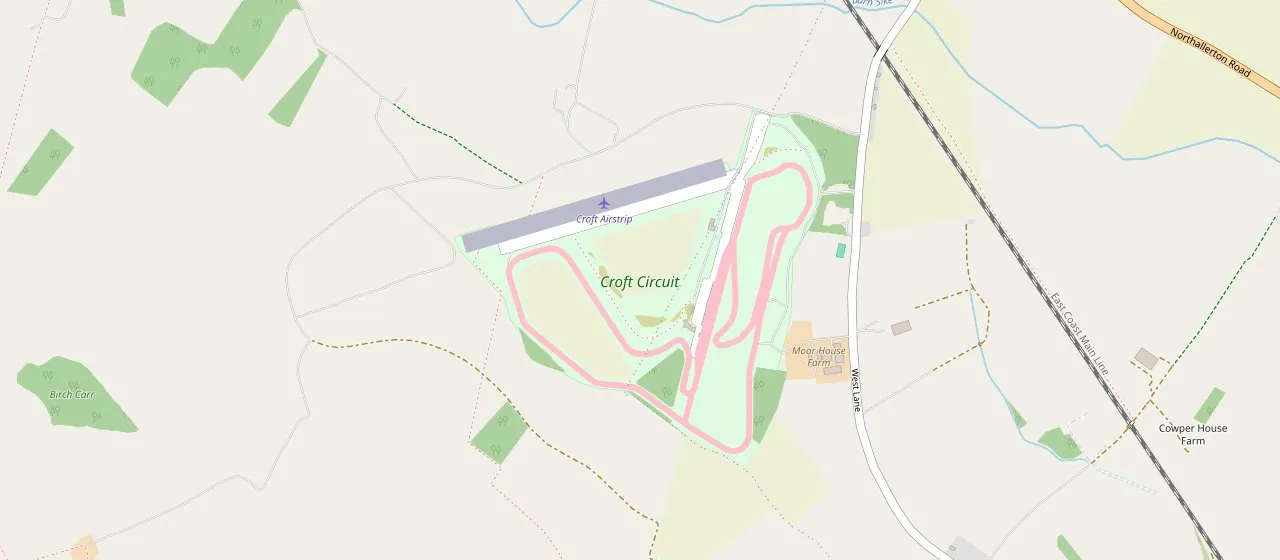
On 26 January 2009 three judges of the Court of Appeal in London settled a dispute that had begun three hundred metres north of the Croft circuit in North Yorkshire. Derek and Julia Watson and their daughter Jill Wilson had no quarrel with the racing. What bothered them were the vehicle testing days and track days, when, as the first-instance judge put it, "members of the public drive vehicles at speed all day". The court limited the loud use of the circuit to 40 days a year. The circuit itself had been built on the runways of a bomber airfield and had already been through a closure, years of rallycross and a return to major racing.
| Location | Dalton-on-Tees, North Yorkshire, about six miles (about 10 km) south of Darlington; address: West Lane, Dalton On Tees, DL2 2PL |
| Type | permanent road circuit on the site of a former military airfield |
| Length | main circuit (since 1997) 3.423 km (2.127 miles); club variants A 1.997 km and B 1.529 km |
| First races | on the airfield in the late 1940s; Croft Autodrome circuit opened on 3 August 1964 |
| Lap record | 1:13.656, Sergio Pérez, Dallara F308 (T-Sport), Formula 3, 27 April 2008 |
| Land and operator | the land remained the property of the Chaytor-Norris family in 2006; the circuit is leased and run by BARC (Croft) Ltd under the trading name Croft Circuit |
| Main events | British Touring Car Championship (BTCC) since 1997; the Battle of Britain meeting of the Darlington club |
| Status | active |
Bombers over Dalton-on-Tees
Approval to requisition the land for an airfield to serve as a satellite of RAF Middleton St George was issued in September 1940. Farmland near the village of Dalton-on-Tees, south of Darlington, was taken for the purpose. A standard Bomber Command airfield with three runways grew up there, in use from October 1941. The first to arrive, on 20 October 1941, was No 78 Squadron RAF. After it came Nos 419, 427, 431 and 434 Squadrons and a unit training crews for heavy bombers. The circuit's operator lists Wellingtons, Halifaxes and Lancasters among the aircraft that flew from here. In the summer of 1946 the airfield was closed for flying.
The concrete runways did not stand empty, however. In the late 1940s the Darlington & District Motor Club began to stage car and motorcycle races on one of the runways and on the perimeter roads, and by 1950 the Royal Automobile Club had approved the course. The 2009 court judgment describes this period more sparingly: between 1949 and 1957 car meetings were held on the airfield intermittently. According to RacingCircuits.info the course drew spectators because there was hardly anywhere else within a reasonable distance where one could watch racing. Flying also returned. In 1951 the airfield was designated a relief landing ground for flying schools and served in that role until the mid-1950s.
The Minister, the Inspector and Four Meetings a Year
In April 1962 the Air Ministry put part of the airfield up for public auction. Part of the land was bought by a group of enthusiasts led by Bruce Ropner. In July the then owner of the airfield applied for permission to hold car and motorcycle races. The local authority refused, fearing the noise, and then also rejected a second application, in which the applicant promised no more than four meetings a year for formula cars.
The appeal was heard at a public hearing in March 1963. The inspector took it as fact that north-east England needed a circuit for cars and motorcycles. He also judged that it had not been shown that the noise would be disturbing enough to reject the proposal, provided that use was restricted by conditions. The Minister accepted his recommendation and on 15 August 1963 granted permission for car and motorcycle events, driving tuition and a sports centre. The permission itself lacked the promised limit of four meetings a year. Thirty-five years later another inspector ruled that a limit that had not been written in did not apply.
The new circuit was ready in July 1964. Nothing of the former airfield course was kept, and the site was called Croft Autodrome for the first time. The lap was roughly triangular: two long straights, fast esses, three tight corners and a chicane made of railway sleepers. Ropner was among the first to drive it, in his Jaguar XK150.
An Autodrome with a Lorry for a Tower
The first meeting, the Daily Mirror Trophy Meeting, took place on bank holiday Monday, 3 August 1964. The crowd was estimated at 30,000 to 50,000 people. The only way into the infield and back was a narrow tunnel north of the pits. A converted lorry stood in for the race control tower, later a double-decker bus, and the paddock was a yard strewn with cinders by the esses. The sources give different lengths for the first lap.
For the next few years the circuit lived mainly on club racing. Its showpiece was the annual Battle of Britain meeting, featuring races for two-, three- and four-wheeled vehicles, with which Croft recalled its aviation past. According to HistoricRacingNews a Lancaster bomber flew over the circuit then, and Stirling Moss was sometimes a guest. In 1970 the Guards International Trophy for Formula 3 was run here, won by Carlos Pace. In the same year, on 11 July, the Interserie came to Croft. Helmut Kelleners won in a March 707 with a Chevrolet engine, and the fastest lap of the race, 1:04.8, was set by Chris Craft in a McLaren M8C.
At the end of 1967 rallycross appeared at Croft, run on part of the tarmac circuit and on a new section with a loose surface. ITV broadcast the events live in its programme "World of Sport". A columnist in Motor Sport wrote in March 1971 that, thanks to the enthusiasm of ITV's Robert Reed, the channel had screened rallycross every year since 1966, first from Lydden, later from Croft, and in the 1970/71 season from Cadwell Park. At Croft a championship without television coverage was then being run, sponsored by the cigarette brand Guards.
The Runways Were to Go Back Under the Plough
In time Croft increasingly lost out to Brands Hatch and Silverstone, and by the end of the 1970s only club racing was left to it. The surface was badly worn, and bringing the circuit up to new safety requirements would have needed a lot of money. In 1979 the airfield, with the circuit, was sold, and soon afterwards racing ceased. In 1981 the new owner applied for permission to pile up mounds of concrete and stone from the runways, which he intended to break up in order to return the land to agriculture. Permission was granted, but the plan was not carried out.
The circuit was saved by rallycross. According to RacingCircuits.info a local farmer, George Shields, came to an arrangement with the new owner of the land, Bill Chaytor, and by April 1982 at the latest cars were racing at Croft again, this time on a course which that website calls the only facility in the country built specifically for rallycross. The court later established that until 1994 there was no racing here apart from rallycross on ten days a year and engine testing. In that period Croft hosted the FIA Nations Cup in rallycross in 1987 and 1990, and in 1994 the British round of the FIA European Rallycross Championship.
A Return with Pumps
The success of rallycross convinced the owner of the land, Kate Chaytor-Norris, to try road racing once more. Around 1994 the company Croft Promo-Sport took a lease on at least the part of the airfield on which the circuit lay, and resumed use of the 1963 permission by laying a new surface. On Sunday 14 May 1995 the Historic Sports Car Club organised a trial meeting at which about 30 cars started. The renewed lap had a chicane on the Railway Straight and a rebuilt section at the Hawthorn corner. The court later noted that in May 1995 a meeting called the Croft Renaissance Meeting took place.
The real leap came at the turn of 1996 and 1997. The £1.5 million rebuild took a little over half a year. The circuit was lengthened to 2.127 miles, or 3.423 km. More than 60 per cent of the lap now ran over the former runways, and in place of the Railway Straight a new complex was built in the infield, with a new start straight. Permanent garages and a race control tower were built for the first time. Racing returned in April 1997.
The aim was a round of the BTCC, the British Touring Car Championship. The series returned to Croft in June 1997, according to Racecar.com after 26 years away. A downpour washed out qualifying, the starting order was set by championship standings, and Sunday's races went ahead only after water had been pumped off the track. Alain Menu won both of them in a Williams Renault Laguna, on his way to the first of his two titles. Tim Harvey, the 1992 BTCC champion, recalled years later the fast bends of the Jim Clark Esses, the technical section of Barcroft and Sunny In, and the hairpin before the finish line, where you want to brake late but can easily ruin the whole lap.
"Croft is a fantastic circuit and unlike anywhere else".
British Formula 3 and British GT also raced at Croft, until 2008. The last F3 season produced the absolute lap record of the current layout: on 27 April 2008 Sergio Pérez lapped it in a T-Sport Dallara F308 in 1:13.656. The British Superbike Championship left the circuit after the 2011 season. Before the 2019 season the whole lap was resurfaced. BTCC drivers predicted that this would end the advantage of rear-wheel-drive cars, which had won 12 of the previous 15 series races at Croft, among other things thanks to a better exit from the tight hairpin before the finish line. "It is like a proper circuit with the new surface, like a Brands Hatch or Donington Park", said Sam Tordoff.
Forty Noisy Days
In 1998 the circuit again came before an inspector, this time over lifting the conditions from 1963. The company, the landowner and a mortgage lender then signed an undertaking that divided days into categories according to noise measured at a set point on the track: no more than 10 days below 95 dBA, 40 days at 93 dBA, 70 days at 85 dBA, 110 days at 78 dBA, and no limit at 70 dBA. The inspector judged that the undertaking would restrict "the almost unrestricted rights which the operators now enjoy to operate the circuit", and granted permission on those terms. From 2000 to 2007 the number of days the circuit was in operation ranged from 144 (2001) to 207 (2000).
The Watsons lived at Vince Moor East, 300 metres north of the circuit. They filed their claim on 16 March 2006. After a six-day trial in Newcastle and a view of the circuit, Judge Simon found on 16 April 2008 that the area had remained essentially rural and that the noise from the circuit was a nuisance to the neighbours within the meaning of the law. He set the limit of reasonable use at 40 days a year in the four loudest categories, but did not issue an injunction and awarded damages totalling £149,600. Both sides appealed.
The Court of Appeal, chaired by the Chancellor of the High Court, Sir Andrew Morritt, dismissed the circuit's appeal and allowed the neighbours'. Damages instead of an injunction, it recalled, may be awarded only in very exceptional circumstances, so Judge Simon should have issued an injunction limiting the circuit to 40 such days a year. The Court of Appeal issued one. Crash.net wrote on the day of the judgment that the circuit's future was in question, that the company had not been given leave to appeal to the House of Lords and had to pay £120,000 in costs straight away. According to RacingCircuits.info, however, the restriction did not change the calendar much, because the major race days bring in most of the circuit's revenue.
Your Own Car on the Runways
The track days that the dispute was about are still held at Croft. The operator runs its own format, Croft Car Track Days, for drivers who are coming to the circuit for the first time or have little experience. There are then no experienced drivers on the track and no race-prepared cars.
In autumn 2026 the full lap is offered by Javelin Trackdays: on Monday 12 October for £239 and on Monday 2 November for £199, in both cases including VAT, with a noise limit of 105 dB measured statically. The organiser stresses that at a trackday you drive your own car, with no lap timing and no competition. It requires a full driving licence or a race licence of at least national grade B, and a foreign driving licence must be shown on the spot. The car must meet at least the requirements of the British MOT test, although it does not have to hold the test certificate itself. Single-seaters, open-wheeled cars and 4x4 vehicles are not admitted. Everyone in the car wears a helmet, and the briefing and sighting laps are compulsory.
The Tenant from Thruxton
In 2006 the running of Croft was taken over by the British Automobile Racing Club (BARC), which already managed, among others, the Thruxton circuit. The land remained the property of the Chaytor-Norris family. The company registered in 1992, which from July 1995 to September 2022 was called Croft Promo-Sport Limited, is today called BARC (Croft) Limited, and its registered office is at the Thruxton circuit. In summer 2021 the head of BARC, Ben Taylor, explained the dropping of rallies and rallycross at Croft partly by the effects of the pandemic: "Croft Circuit lost ten times more money in 2020 than it made in 2019". He added that BARC is not the landowner but a tenant with a long-term lease. For 29 November 2026, however, the operator announces the Christmas Stages Rally again.
The biggest event of the year remains the BTCC. For 5 and 6 September 2026 the circuit's operator announced rounds 22–24 of the series, with 14 races on the weekend's programme. Two weeks earlier, on 22 and 23 August, the Darlington & District Motor Club announced its annual Battle of Britain, with rounds of the Northern Saloon and Sports Car Championship and sidecar motorcycle races on the full lap. The club that staged the first races on the runways in the late 1940s still organises its meeting here.
Timeline
- 1940: approval to requisition land for a satellite airfield of RAF Middleton St George.
- 1941: RAF Croft airfield begins operating; on 20 October No 78 Squadron RAF arrives.
- 1946: airfield closed for flying.
- late 1940s: first Darlington & District Motor Club races on the runways.
- 1951: airfield designated a relief landing ground for flying schools.
- 1962: auction of part of the airfield; Bruce Ropner's group buys part of the land.
- 15 August 1963: the Minister permits car and motorcycle racing.
- 3 August 1964: first meeting at Croft Autodrome.
- end of 1967: rallycross, broadcast by ITV, starts at Croft.
- 1970: Guards International Trophy for Formula 3 won by Carlos Pace; an Interserie round.
- 1979: airfield sold together with the circuit; soon afterwards road racing ends.
- April 1982 at the latest: rallycross on the new course.
- 1987 and 1990: FIA Nations Cup in rallycross; 1994: round of the FIA European Championship.
- May 1995: first race meeting in years, on 14 May, with the Historic Sports Car Club.
- 1997: £1.5 million rebuild, 3.423 km lap, BTCC returns in June.
- 1998: noise undertaking and new planning permission.
- 2006: BARC takes over running the circuit; the neighbours file their claim.
- 27 April 2008: Sergio Pérez's lap record in Formula 3.
- 26 January 2009: the Court of Appeal limits loud days to 40 a year.
- 2019: new surface over the whole lap.
- 2022: Croft Promo-Sport Limited changes its name to BARC (Croft) Limited.